How to Choose a Cardano Stake Pool
Staking ADA is relatively simple, very secure, and does not require any lock-up period. The more difficult question is:
“Which Cardano stake pool should I choose?”
To choose a Cardano stake pool, first compare its fee structure and active stake relative to saturation. Fees directly affect the share of pool rewards distributed to delegators, while pool size mainly affects how regularly rewards are received. Then consider network and decentralization factors such as whether the operator runs one pool or multiple pools and whether its declared pledge is met. Metrics such as ROA, luck and total block count can provide useful context, but should not be used alone to choose a pool.
There is no single metric that identifies the best stake pool. A useful comparison therefore separates economic criteria from network and decentralization criteria.
Cardano Stake Pool Selection Criteria
Economic Criteria
1. Fee Structure
2. Pool Size & Saturation
Network & Decentralization Criteria
3. Single-Pool vs. Multi-Pool Operator
4. Pledge
Interpret Carefully
Recent ROA · Lifetime ROA · Luck · Block History
Economic Criteria
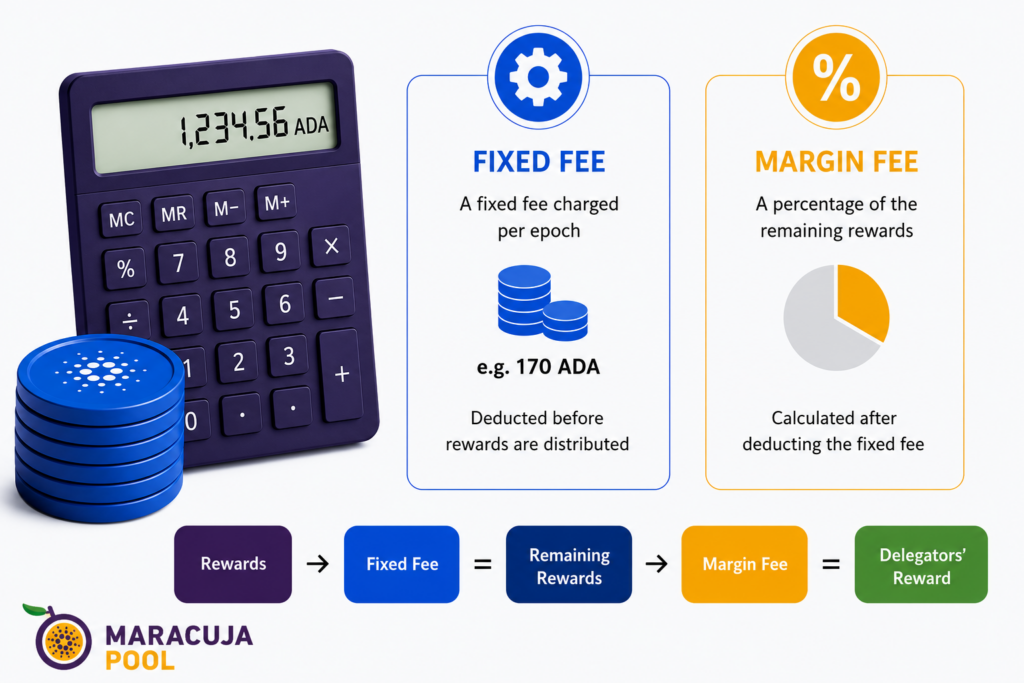
1. Fee Structure: Fixed Fee & Margin
Stake pool fees have a direct influence on the share of pool rewards that remains for delegators. When comparing pools, look at the complete fee structure rather than the margin alone.
Fixed Fee
The fixed fee is deducted from the pool’s rewards before the remaining rewards are distributed to delegators. Cardano defines a protocol-level minimum pool cost.
The fixed fee is especially relevant when comparing smaller pools. For pools producing fewer blocks per epoch, the fixed cost generally represents a larger share of the total pool rewards. As the pool produces more blocks, the same fixed cost usually represents a smaller proportion of the reward pot.
Margin
The margin is the percentage the operator receives from the rewards remaining after the fixed cost has been deducted. A lower margin generally leaves a larger share for delegators, all else being equal.
Important: A 0% margin does not automatically make a pool the best choice. Fixed cost, pool size and the resulting reward distribution should be considered together. For a detailed explanation of how these components affect rewards, see our Cardano staking rewards guide.
2. Pool Size & Saturation
Pool size mainly affects how regularly a stake pool is selected to produce blocks. Smaller pools can provide competitive long-term rewards, but their rewards usually fluctuate more from epoch to epoch because blocks are produced less frequently.
As a practical orientation under current network conditions, a pool with around 1–1.5 million ADA in active stake can be expected to produce roughly 1–1.5 blocks per epoch on average. Rewards therefore tend to become noticeably more regular around this range, although epochs without a block can still occur. This is a practical orientation, not a Cardano protocol threshold.
Once a pool is large enough to produce blocks regularly, additional stake primarily reduces short-term reward variation rather than automatically producing a higher long-term return for each delegated ADA.
Watch the Saturation Level
Cardano limits the stake that contributes to a pool’s maximum rewards through the saturation mechanism. Once a pool reaches its saturation point, additional delegated stake does not increase its maximum pool rewards proportionally.
Instead of relying on a fixed ADA number, check the pool’s current saturation percentage in a Cardano explorer before delegating. The saturation threshold can change as relevant network conditions and protocol parameters change.
Network & Decentralization Criteria
3. Single-Pool vs. Multi-Pool Operator
Economic returns are not the only consideration when choosing a stake pool. Your delegation also influences how stake is distributed among operators across the Cardano network.
A Single-Pool Operator runs one stake pool, while a Multi-Pool Operator controls multiple pools. Delegating to independent single-pool operators can help distribute stake across a larger number of independent operators instead of concentrating it within a smaller number of organizations.
Single-pool status should therefore be understood as a decentralization criterion, not as evidence of higher rewards or better technical performance. If you want to understand the role of stake pools within Cardano in more detail, see what a Cardano stake pool is and how it works.
4. Pledge
Pledge is ADA committed to the pool by its owner or owners. It is both an economic protocol parameter and part of Cardano’s mechanism for discouraging Sybil-style pool proliferation.
A higher pledge can increase the theoretical rewards of an otherwise equivalent pool, but pledge should not be treated as a simple “higher is always better” ranking metric. Its influence on rewards is determined by Cardano’s pledge influence parameter.
More important is whether the pool actually meets its declared pledge. If the owners collectively fail to meet the declared pledge, the pool does not receive pool rewards for that epoch.
How to Interpret Stake Pool Performance
Stake pool explorers provide many performance metrics, but they should not all be treated as independent selection criteria. Some describe past outcomes rather than factors that determine future rewards.
Recent ROA
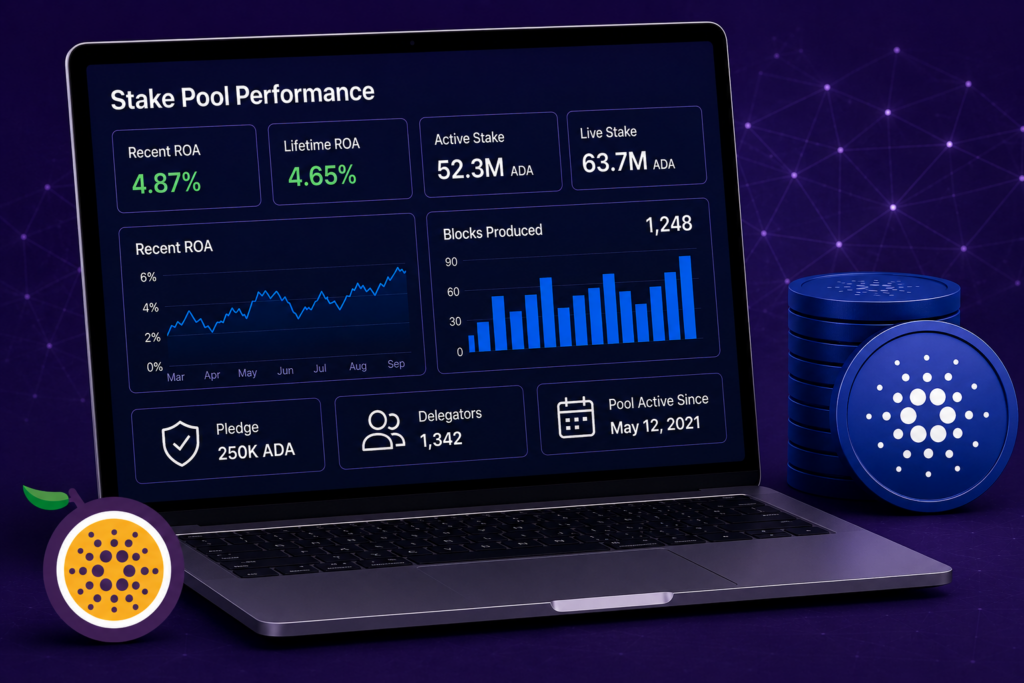
Recent Return on ADA (ROA) shows the annualized reward performance achieved over a recent period. It can be useful as a historical reality check, but it is not a forecast of future rewards.
Short-term ROA is affected by the random nature of Cardano’s block assignment. A temporarily high Recent ROA does not mean that the pool is technically better, and a temporarily lower value does not necessarily indicate poor operation.
Lifetime ROA
Lifetime ROA should be interpreted particularly carefully when comparing pools of different ages. Part of Cardano’s staking rewards comes from monetary expansion, and the amount released from the remaining reserve declines over time. Older pools therefore include periods with a different overall reward environment in their lifetime figures.
Luck
Luck reflects statistical variation in block production. Values above or below 100% over a limited period are not, by themselves, evidence that an operator is performing better or worse.
Luck fluctuates around its statistical expectation over time. Past luck does not predict whether a pool will be lucky or unlucky in future epochs.
Block History
The total number of blocks a pool has produced is useful background information, but it is not a complete measure of technical reliability. Larger and older pools will naturally tend to have produced more blocks.
Public block history also does not tell a delegator everything about a pool’s private leadership schedule. The number of produced blocks alone therefore cannot show whether every block opportunity assigned to the pool was successfully produced.
Active Stake vs. Live Stake
Active Stake is the stake currently used for block production and reward calculations. This is the more relevant figure when assessing the pool’s current size.
Live Stake reflects the stake currently delegated to the pool, including recent delegation changes that may not yet be active for block production. Differences between live and active stake are therefore normal.
If you want to understand why stake and rewards change between epochs, see our Cardano staking rewards guide.
Other Reasons for Choosing a Stake Pool
Not every reason for choosing a stake pool is economic. Delegators may also prefer operators whose values or operating principles match their own priorities.
- renewable energy and sustainability
- charitable commitments
- clear operator information and communication
- long-term commitment to the Cardano ecosystem
These factors do not directly increase staking rewards, but they can still be legitimate considerations when deciding which operator you want to support with your delegation.
Conclusion: Choosing a Cardano Stake Pool
When choosing a Cardano stake pool, start with the factors that have the clearest economic relevance: fees, active stake and saturation. Then consider whether supporting an independent single-pool operator and the pool’s pledge are important to your view of Cardano’s decentralization.
Do not select a pool simply because it currently has the highest ROA, the highest luck or the largest number of historical blocks. These metrics describe past outcomes and need context. The best choice depends on the combination of economic characteristics, decentralization preferences and any personal priorities you want your delegation to reflect.
Frequently Asked Questions
Start with the pool’s fee structure, active stake and saturation. These are the most useful economic criteria for comparing pools. You can then consider network and decentralization factors such as whether the operator runs one pool or multiple pools and whether its declared pledge is met. Metrics such as ROA, luck and total blocks should be interpreted in context rather than used alone.
Cardano stake pool fees consist of a fixed pool cost and a margin. The fixed cost is deducted from the pool rewards first, followed by the operator’s margin. The remaining rewards are distributed proportionally among the pool’s stakeholders. The fixed cost can have a greater relative impact on smaller pools that produce fewer blocks.
There is no required minimum pool size for delegation. As a practical orientation under current network conditions, pools around 1–1.5 million ADA in active stake can be expected to produce roughly 1–1.5 blocks per epoch on average, making rewards increasingly regular. Smaller pools can still provide competitive long-term rewards but usually have greater epoch-to-epoch variation. This range is not a Cardano protocol threshold, and saturation should always be checked separately.
No. Recent ROA describes past rewards and can be influenced by normal statistical variation in block production. Lifetime ROA is also difficult to compare across pools of different ages because Cardano’s overall reward environment has changed over time. ROA is useful context, but it should not be used as a standalone ranking metric.
Yes. Pledge is part of Cardano’s pool reward formula, and its influence is determined by the pledge influence parameter. A higher pledge can increase the potential rewards of an otherwise equivalent pool. More importantly, the pool owners must meet their declared pledge; otherwise the pool receives no pool rewards for that epoch.
Choosing a single-pool operator can help distribute stake across a larger number of independent Cardano operators. This is a decentralization consideration rather than evidence that the pool will provide higher rewards or better technical performance.
Cardano caps the stake that contributes to a pool’s maximum rewards at the saturation point. Once a pool is saturated, additional delegated stake does not increase its maximum rewards proportionally. Check the pool’s current saturation percentage in a Cardano explorer before delegating.