Cardano Epochs Explained: How They Affect ADA Delegation and Rewards
A Cardano epoch is a fixed five-day period made up of 432,000 one-second slots. Epochs determine when stake snapshots are taken, when delegation changes become active for block production, and when staking rewards are calculated and paid.
Cardano Epochs at a Glance
- Epoch length: 5 days
- Slots per epoch: 432,000
- Slot length: 1 second
- Delegation changes: captured at an epoch boundary and become active with a delay
- First rewards after a new delegation: usually around 15–20 days, depending on when you delegate within the current epoch
- Ongoing rewards: paid every epoch when the delegated pool earns rewards
What Is a Cardano Epoch?
An epoch is one of the fixed time periods used by Cardano’s Ouroboros proof-of-stake protocol. Each epoch contains 432,000 slots, and each slot lasts one second. This means one Cardano epoch currently lasts exactly five days.
Slots are the smaller time units in which block-producing nodes can be selected. Epochs group those slots into a stable cycle so the protocol can work with a defined stake distribution when selecting stake pools for block production.
Epoch vs. slot: a slot is a one-second opportunity in which a block producer may be selected. An epoch is the five-day cycle containing 432,000 of those slots.
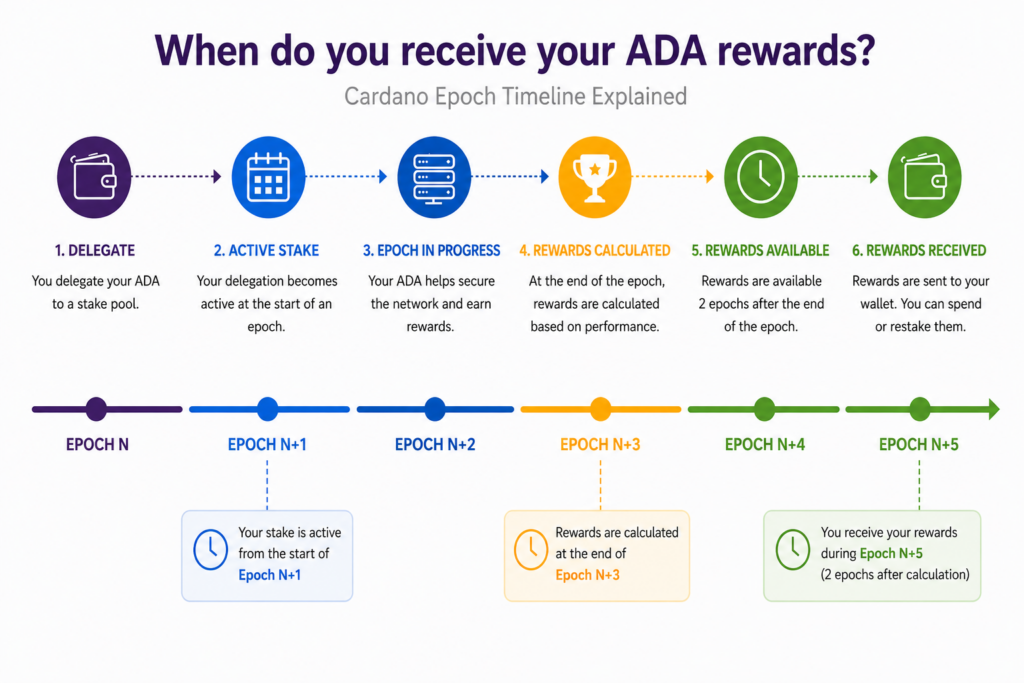
Why Epochs Matter for ADA Delegators
For a delegator, epochs mainly matter because changes are not reflected instantly in Cardano’s staking process. A new delegation, a pool switch, or a change in the ADA balance of your staking wallet first has to pass through the protocol’s snapshot and reward cycle.
This delay is normal. It does not mean your delegation failed, and it does not mean your ADA are locked. Cardano delegation remains non-custodial: your ADA stay in your wallet and can be spent at any time.
From Delegation to First Rewards: The Epoch Timeline
If you make a new delegation during Epoch N, the simplified Cardano reward timeline looks like this:
Epoch N
You delegate or change pools. The change is recorded on-chain during the current epoch.
N → N+1
The stake snapshot captures the change. This snapshot is not yet the active stake used for block production in N+1.
Epoch N+2
Your delegation becomes active for block production. The pool’s active stake now includes the captured delegation for this epoch.
Epoch N+3
Rewards from N+2 are calculated. The protocol accounts for the pool’s block production, reward parameters, fees and delegated stake.
Start of Epoch N+4
The rewards become available. Because you can delegate at any point during Epoch N, the real-world wait from delegation to first payout is usually around 15–20 days.
Important: The first payout is delayed, but you are not “missing” reward epochs. Once the initial pipeline is established, rewards can arrive every five days for earlier active epochs, provided the pool earned rewards.
What Happens If You Add, Spend or Move ADA?
Cardano staking is based on the stake associated with your registered staking credential. You do not lock ADA into the stake pool. Changes to the ADA balance in your wallet are reflected through future stake snapshots.
- Add ADA: the larger balance can be picked up by a later snapshot and then contribute to future active stake and rewards.
- Spend or transfer ADA: you can use your ADA normally. A lower wallet balance will be reflected in future staking snapshots.
- Switch stake pools: the new delegation follows the same delayed epoch transition before it becomes active.
- No manual re-delegation after balance changes: if the staking credential remains delegated, the protocol tracks the changing balance automatically through snapshots.
Why Can Rewards Differ Between Epochs?
Even after the initial waiting period, staking rewards do not have to be identical every five days. Cardano’s block production is probabilistic, and a pool’s actual rewards can vary from epoch to epoch.
- the pool’s active stake and saturation level
- how many blocks the pool is expected to produce
- how many blocks it actually produces
- the pool’s declared fixed cost and margin
- pledge and Cardano protocol parameters
- transaction fees and monetary expansion available for rewards
For the deeper reward mechanics, see our Cardano Staking Rewards Guide. If you are comparing pools, use our Cardano Stake Pool Selection Guide.
Cardano Epoch FAQ
How long is a Cardano epoch?
A Cardano epoch currently lasts exactly five days and contains 432,000 one-second slots.
When does a new Cardano delegation become active?
If you delegate during Epoch N, the change is captured at the next epoch boundary and typically becomes active for block production in Epoch N+2.
How long until the first ADA staking rewards arrive?
For a new delegation, the first rewards usually arrive after roughly 15–20 days. The exact wait depends on when during the current five-day epoch you submit the delegation.
Do I lose rewards during the initial waiting period?
No. The delay is part of Cardano’s normal snapshot and reward pipeline. Your delegation must first become active, then the relevant epoch’s rewards are calculated and later distributed.
Can I spend ADA while it is delegated?
Yes. Delegation does not transfer your ADA to the stake pool and does not lock the funds. You can spend or transfer ADA at any time; balance changes are reflected in later stake snapshots.
Are staking rewards guaranteed every epoch?
No. Rewards depend on whether the delegated pool earns rewards for the relevant epoch. Block production is probabilistic, so especially smaller pools can have epochs with more, fewer or no blocks before results average out over longer periods.
Related Cardano Guides
- Cardano Staking Rewards Guide – how ADA staking rewards are calculated and what affects them.
- How to Choose a Cardano Stake Pool – the six most useful criteria for comparing pools.
- What Is a Cardano Stake Pool? – how stake pools and relays fit into Cardano’s proof-of-stake system.
- Cardano Blockchain Explained – a broader introduction to the network.
Official Sources
- Cardano Docs – Cardano nodes: Slots and epochs
- Cardano Docs – Delegation
- Cardano Docs – Pledging and rewards
- Cardano Glossary – Rewards
Last reviewed: September 2026. Cardano protocol parameters and staking mechanics can change; this guide is periodically checked against current official Cardano documentation.